In-vitro meat – This is what happened at the market in 2020
There are many good reasons to avoid eating meat. Animal welfare, global warming or environmental protection, to name the most important three. These topics are being addressed and discussed more and more often in public now.
Companies, that offer meat substitutes, therefore have barely any problems finding investors. This was demonstrated by Beyond Meat’s record-breaking IPO last year. And this trend is continuing this year. In addition to meat alternatives made from plants or insects, in-vitro meat, i.e. meat produced in the laboratory, is attracting more and more attention.
Big Steps in 2020

This year has seen many important developments involving in-vitro meat. That is something, the experts agree on. Fabio Ziemssen, CEO of NX-Food, speaks of „a big year for the cultured meat market.“ Albrecht Wolfmeyer of ProVeg Incubator also shares this view, saying „2020 was a very strong and important year for cellular agriculture.“ They also have good arguments for this optimism.
In November, the startup SuperMeat opened the first restaurant in Israel, that serves cultured meat. Interested parties can book a table there, to have the production process of the meat explained to them and try the chicken from the lab on a burger.
Currently, the meal is actually free of charge. All SuperMeat wants in return is customer feedback. In this way, the startup avoids the problem, that there is still no final legal regulation for the sale of in-vitro meat in Israel.
Since the beginning of this month, chicken meat from laboratories can be sold in Singapore. There, the American startup Eat Just managed to have its „chicken bites“ tested and approved by the Food Safety Authority. This makes the island city the first country in the world, to make in-vitro meat freely available for sale.
Meat from the petri dish and not from cows
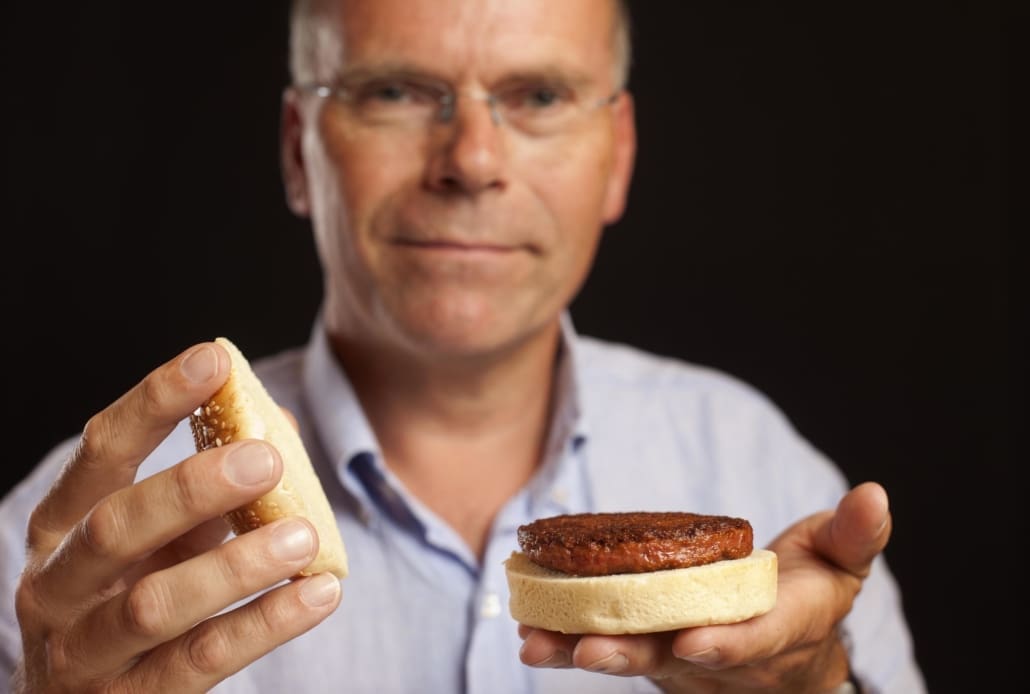
Cultured meat has come a long way. In 2013, Mark Post from Maastricht University succeeded in serving the first farmed burger. But this still cost around 250,000 euros. The cost of lab-grown meat has been dropping rapidly ever since. Two years later, the Belgian startup Mosa Meat, whose co-founder is Mark Post, announced, that it could produce a burger for around 70 euros. However, the burgers are not yet ready for the market. Mosa Meat does not plan to reach mass production for another three to four years.
The company’s investors also believe this. In the Series B financing round, which lasted from September to December, the Belgians managed to raise $75 million.
Aleph Farms is working on two remarkable projects at once in Israel. In November of this year, the company presented its artificial steak to the world. Not only does it taste like its natural counterpart, but by 2022 the production will be up and running and the meat will be available to consumers for normal prices.
The Israelis‘ second project sounds, as if it came straight out of Star Trek. Last year, they succeeded in growing meat on the International Space Station (ISS). They had to overcome the difficulty of producing edible meat under microgravity and far away from all resources. In the future, they plan to continue working on this process. Founder Didier Toubia’s declared goal: „When people live on the moon or Mars, Aleph Farms will be there, too.“
There’s not only meat, but also fish in the U.S.
The Washington DC-based Good Food Institute (GFI) announced a collaboration with the World Sustainability Organization (WSO) this year. The WSO will initiate a certification program for plant-based seafood. In the future, these will be labeled with the „Friend of the Sea“ standard, to identify environmentally friendly foods. This should help the industry and accelerate market developments.
It is still questionable, whether the label will also certify farmed fish. Its development is currently being pushed forward in the USA. The startup BlueNalu from San Diego, California, is researching how to grow seafood from fish cells. This is supposed to work in a similar way to land mammals and help combat overfishing of the oceans.
The startup Memphis Meat is conducting research on in-vitro fish and meat in the same state. It describes itself as the world’s leading company in the field of cultured meat. Many investors also seem to believe the statement. This year, the team from Berkeley received a total of 161 million US dollars. Among others, Microsoft founder Bill Gates was involved in the financing round. He has already invested in the company in the past.
In addition to private research, a government funded project has also been launched in the USA this year. With support totaling 3.65 million US dollars, open access research on cultured meat was launched at the University of California.
To start the project, the researchers received US$1.25 million upfront, with another US$2.4 million to come, if the project makes good progress in the first two years. This makes the project the largest U.S. cultured meat research initiative to date.
Just little in-vitro research in Germany

So far, the major breakthroughs in the in-vitro field originate from the rest of the world, rather than from Germany. The Ministry of Education’s extended the Science Year 2020|21, to help this situation. The focus is on the bioeconomy. In the program, concepts against climate change are to be discussed and implemented. The problem, which needs to be solved, is the limited agricultural area with a simultaneously growing world population.
Part of the solution to this problem would be artificial meat. This is also shown in the study „Meat of the Future“ by the Federal Environment Agency. So far, there is only one company in Germany researching in-vitro meat: Innocent Meat from Rostock.
„Meat production has been shown to harm the environment and contribute to global warming. Our study shows: Meat substitutes could play a big role in a more environmentally friendly and also healthier diet.“
Dirk Messner, President of the Federal Environment Agency
But why isn’t more research on farmed meat going on in Germany yet? „As long as the price of food does not also reflect the environmental damage, the cheap steak will continue to get preference over a soy cutlet. This is where politics is called upon to change these framework conditions,“ Messner explains.
At the moment, therefore, it is primarily the political framework conditions and public acceptance, that are standing in the way of lab-grown meat.
Want to know more about in-vitro startups?
Then you can get to know the 8 hottest ones here!
Featured Picture: Memphis Meat